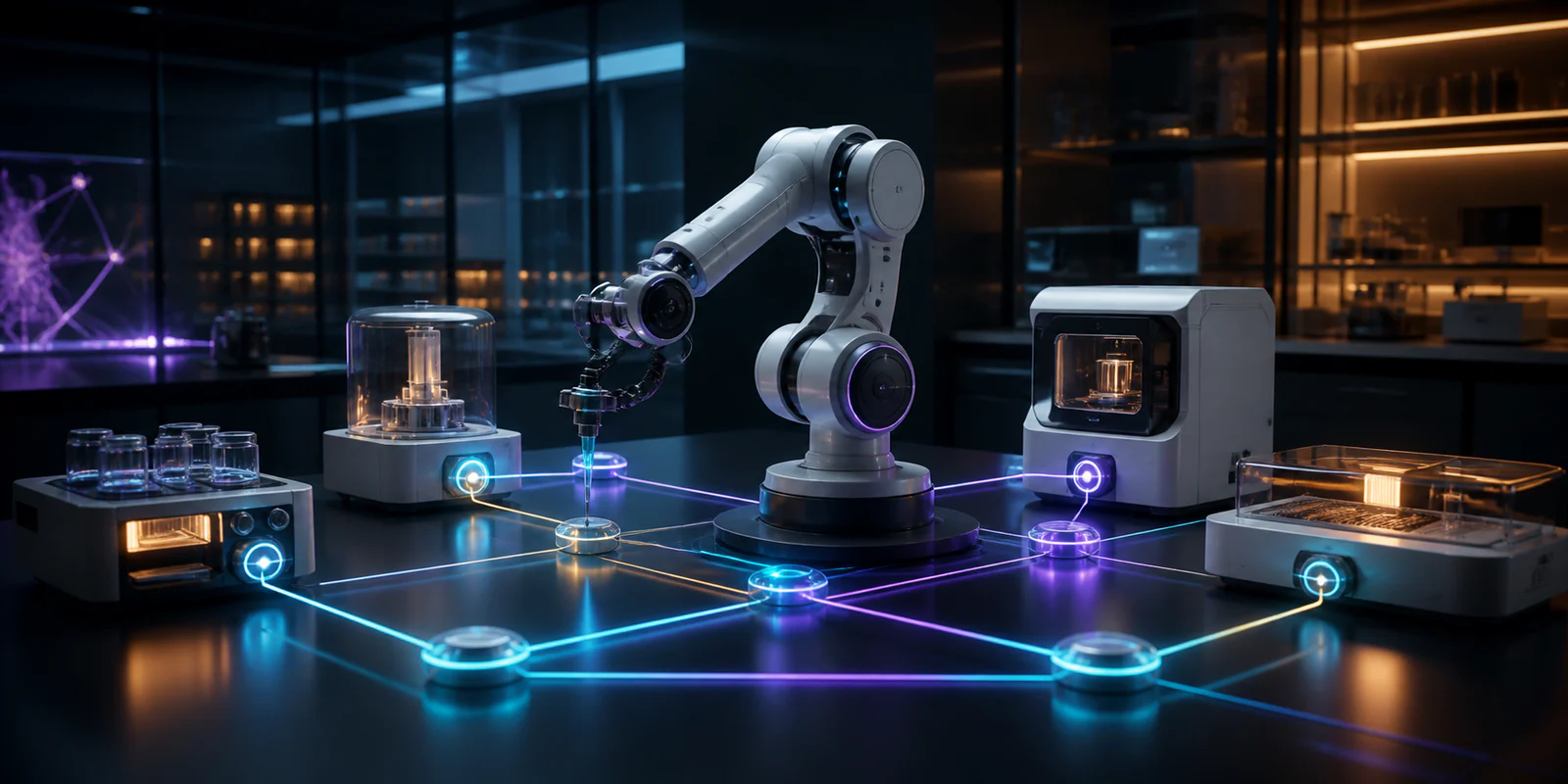
Anthropic is extending the protocol idea behind tool-using AI into the physical world. On August 27, the company opened a research preview of the Model Hardware Standard, or MHS, a shared interface intended to help AI agents discover, understand and operate programmable laboratory and manufacturing equipment.
The proposal targets an unglamorous but expensive bottleneck: instruments from different vendors often expose incompatible software interfaces. Researchers and engineers can spend weeks building one-off integrations before an automated workflow performs a single useful experiment. MHS tries to replace much of that glue code with standardized drivers and a small, common set of operations.
This is not a general release or a finished safety standard. Access is initially limited to selected research labs, manufacturers and technology partners. Anthropic says it plans to open-source MHS after the preview, once participants have helped develop evaluations and operating practices for agents controlling real equipment.
How the standard works
At the center of MHS is a device driver that translates a machine’s existing programming interface into common primitives, such as reading or writing a value. The driver also advertises the device in a standard format so agents and other equipment can find it across a network without a bespoke translator for every connection.
A metadata layer is meant to capture information software cannot infer safely from an API alone: the weight and range of a robotic arm, the quantities an instrument can measure, adjustable parameters and enforced safety limits. An operator can write those details in natural language or provide them through an agent-led setup conversation. The driver then produces a reference file that an agent can consult before acting.
MHS supports three control paths: Anthropic’s Model Context Protocol, a command-line interface and conventional code or APIs. That mix is important. A model can reason about a high-level task, but long or time-sensitive operations can be compiled into deterministic scripts rather than requiring fresh model decisions at every step.
Anthropic says MHS is model-agnostic and can work with any device that has a programmable interface. Independent reports from Ars Technica and Reuters confirm that the current program is a research preview ahead of a planned open-source release.
Early results are promising, but vendor-reported
Anthropic described several early projects developed with research and industry partners. Genentech tested a proof of concept coordinating a liquid handler, robotic arm and plate reader for a protein assay. Carnegie Mellon researchers used an agent to orchestrate instruments across three computers for dose-response experiments, which Anthropic says ran about three times faster than the previous process. QuEra used the system in laser stabilization for quantum hardware and reported that an agent-built controller recovered laser lock without human intervention in 99.3% of attempts.
Those examples show the kind of interoperability MHS is designed to enable, not broadly validated benchmarks. They come from Anthropic and participating partners, cover different workflows and do not establish that the same performance will transfer to other laboratories. Prospective users should look for reproducible driver tests, failure-rate reporting and independent safety evaluations as the preview expands.
The partner list nevertheless gives MHS a credible route to adoption. AWS plans support through its Strands Robots library. Automata, Doosan Robotics, QIAGEN, Tecan and Universal Robots are among companies testing or developing integrations. Hugging Face is adding support to its LeRobot library, while Raspberry Pi is working on integrations for its hardware.
The physical safety problem cannot be abstracted away
A shared interface makes automation easier; it also makes mistakes easier to scale. A faulty software action can corrupt a file. A faulty hardware action can spill a reagent, damage an instrument or put a person at risk. Standardized metadata and enforced limits are useful, but they are not substitutes for interlocks, emergency stops, access controls and human supervision.
Anthropic acknowledges that current language models have limited spatial and physical intuition. In one example, Genentech researchers had to help Claude recognize that foaming in a sample was a physical problem rather than a software fault. The standard also cannot connect directly to equipment without a programmable interface, leaving older devices dependent on new vendor drivers or external control hardware.
For safety-critical deployments, teams should keep the model above a deterministic control layer. The agent can propose a plan, choose among validated procedures or adapt parameters inside an approved range; a separate system should enforce hard limits and require human authorization for high-consequence actions. Device identity, commands and sensor feedback should be logged independently of the model’s own transcript.
Why MHS could matter beyond one vendor
Anthropic launched the Model Context Protocol as a way to connect models with software tools and data. MHS applies a similar architectural idea to machines: common discovery, common descriptions and common operations, while leaving the underlying equipment and model replaceable.
If vendors adopt it and the specification is genuinely developed in the open, MHS could reduce integration costs for small labs that cannot maintain custom automation teams. It could also make workflows more portable across facilities and lower the friction of replacing either an instrument or an AI model. The model-agnostic commitment is therefore more than a technical detail; it is central to avoiding a new layer of hardware lock-in.
The near-term question is not whether an agent can move a robot arm in a demo. It is whether MHS can become a stable, auditable contract between probabilistic models and equipment that demands deterministic safety. The research preview is a sensible place to answer that question—provided the eventual open-source release includes the failure data and guardrails, not only the interface.